
Non-abrasive
Cleans without eroding the substrate beneath the contamination.
Industrial cleaning · North West
Industrial cleaning without water, chemicals or abrasive media. Safe, efficient cleaning solutions for machinery, equipment and sensitive industrial environments.
The process
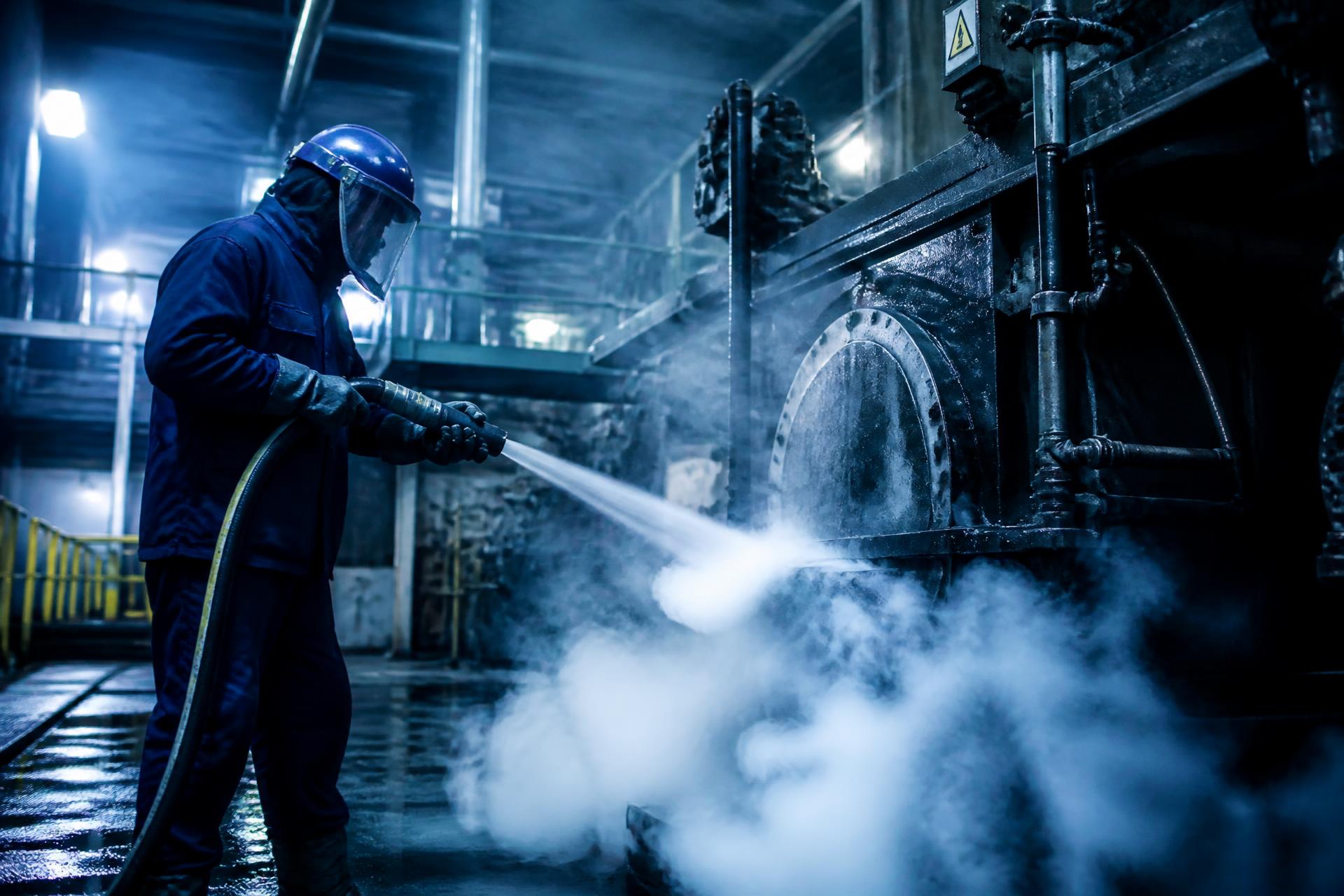
Solid CO₂ pellets are accelerated by compressed air and sublimate on impact — lifting contamination away without leaving any blasting media behind.
Food-grade solid CO₂ pellets are loaded into the blast machine — a recycled by-product, not a manufactured abrasive.
The pellets are propelled through a specialist nozzle at high velocity, directed precisely at the contaminated surface.
At −78°C the pellets rapidly cool and embrittle the contaminant, breaking its bond with the substrate underneath.
The dry ice turns straight from solid to gas, helping lift contamination away without leaving blasting media behind.
No grit, no slurry, no waste water — just the removed residue to collect, so downtime and clean-up are dramatically reduced.
Pellet → impact → sublimation
No secondary blasting media to clean up afterwards.
Reduced downtime compared with many traditional cleaning methods.
Benefits
A dry, non-abrasive process designed around live production environments.
Cleans without eroding the substrate beneath the contamination.
A completely dry process — no drying time and no water ingress risk.
No solvents or detergents introduced into your environment.
The media sublimates, so only the removed contaminant is left to collect.
Often carried out in place, cutting strip-down and reassembly time.
Suitable for many sensitive surfaces where correctly assessed and tested first.
Uses reclaimed CO₂ and creates no waste-water run-off to dispose of.
High-throughput cleaning of complex geometry that hand cleaning can't reach.
Applications
From food-grade production lines to fire damage restoration, dry ice blasting adapts to the environment.
Production plant, tooling and machine housings cleaned between runs.
Precision components, jigs and fabrication equipment de-greased in place.
Hygiene-critical lines cleaned dry, with no water or chemical residue.
Paint shop equipment, moulds, engines and workshop plant.
Press rollers, drying units and ink build-up removed without dismantling.
Controlled environments and process equipment cleaned to specification.
Racking, structural steel, ductwork and high-level dust removal.
Panels, motors and switchgear cleaned dry — no moisture introduced.
Fire residue, soot, adhesives and heritage surface restoration.
Not sure whether dry ice suits your sector? We'll attend site, test a sample area and put the results in writing — free of charge.
Book a free site surveyWhat we clean
Hover or tap any item to see how dry ice blasting is applied.
Built-up production residue removed in place, often while still assembled.
Conveyor frames, guarding and machine surfaces cleaned between shifts.
Dust, oil films and carbon lifted without solvents or water.
Dry cleaning of panels, contacts and enclosures with no moisture risk.
Belts, rollers and structures freed of product build-up and grease.
Release agent and cure residue removed without damaging tool surfaces.
Oil-soaked plant cleaned back to a serviceable, inspectable condition.
Heavy grease deposits broken down and lifted without degreasing chemicals.
Oil films and drips removed from plant, frames and floors-side equipment.
Baked-on carbon and soot removed from ovens, burners and exhaust plant.
Glue, tape and label residue removed from tooling and surfaces.
Cured sealant and mastic residue stripped from fixtures and equipment.
Smoke, soot and char removal as part of fire damage restoration.
General plant, structural steel and ancillary equipment cleaning.
Method comparison
How the four common industrial cleaning methods compare on the criteria that matter to production teams.
| Criteria | Dry ice blasting | Pressure washing | Sand blasting | Chemical cleaning |
|---|---|---|---|---|
| Water used | None — completely dry | High volume | Usually none | Rinse water required |
| Abrasive to substrate | Non-abrasive | Can erode soft surfaces | Highly abrasive | Can etch or stain |
| Secondary waste | Contaminant only — media sublimates | Contaminated run-off | Spent grit to bag and dispose | Chemical effluent |
| Clean in place | Usually yes, often while warm | Rarely near electrics | Strip-down normally needed | Depends on dwell and rinse |
| Electrical & motor safe | Yes — no moisture introduced | High ingress risk | Media ingress risk | Residue and moisture risk |
| Chemicals introduced | None | Often detergents | None | Solvents and detergents |
| Downtime | Low — minimal strip-down or drying | Drying time required | High — masking and clean-up | Dwell, rinse and dry time |
| Food & hygiene environments | Well suited — food-grade CO₂ | Water and aerosol concerns | Generally unsuitable | Strict controls required |
| Clean-up afterwards | Sweep or vacuum residue | Water containment | Extensive media recovery | Effluent handling |
Why Arctic
A commercial and industrial cleaning partner set up for compliance, scheduling and minimal disruption.
Uniformed, trained operatives, clear communication and a documented finish.
Comprehensive public liability cover — certificates supplied on request.
We attend, assess the contamination and test an area before quoting.
Risk assessments and method statements issued where required.
Nights, weekends and shutdown windows to suit your production plan.
Cleaning in place wherever possible, with containment and extraction.
Liverpool, Merseyside, Wirral, Lancashire, Cheshire and Greater Manchester.
Experienced across manufacturing, food, facilities and property.
Before & after
Real Arctic project photography, added as each industrial contract completes.
Project gallery coming soon
Real Arctic dry ice blasting project photography will appear here.
Project gallery coming soon
Real Arctic dry ice blasting project photography will appear here.
Project gallery coming soon
Real Arctic dry ice blasting project photography will appear here.
FAQs
Still unsure whether dry ice is right for your equipment? Book a free survey and we'll test an area first.
Tell us what needs cleaning, upload a few photos and choose how you'd like us to get back to you. We'll attend site, test an area and send a written quotation — no obligation.
Covering Liverpool, Merseyside, Lancashire, Wirral, St Helens, Warrington and the wider North West.